Off-Grid Solar-Powered Multi-Lens Surveillance Camera System with Active Deterrence

Description

Wide-Area Outdoor Surveillance with Grid-Independent Operation


* Lens Specifications: 4mm + 4mm + 4mm;
* Resolution: Main stream 1920 × 3240, Sub-stream 640 × 1080 @ 15fps;
* Video Storage: Supports TF card (32~256G) video storage;
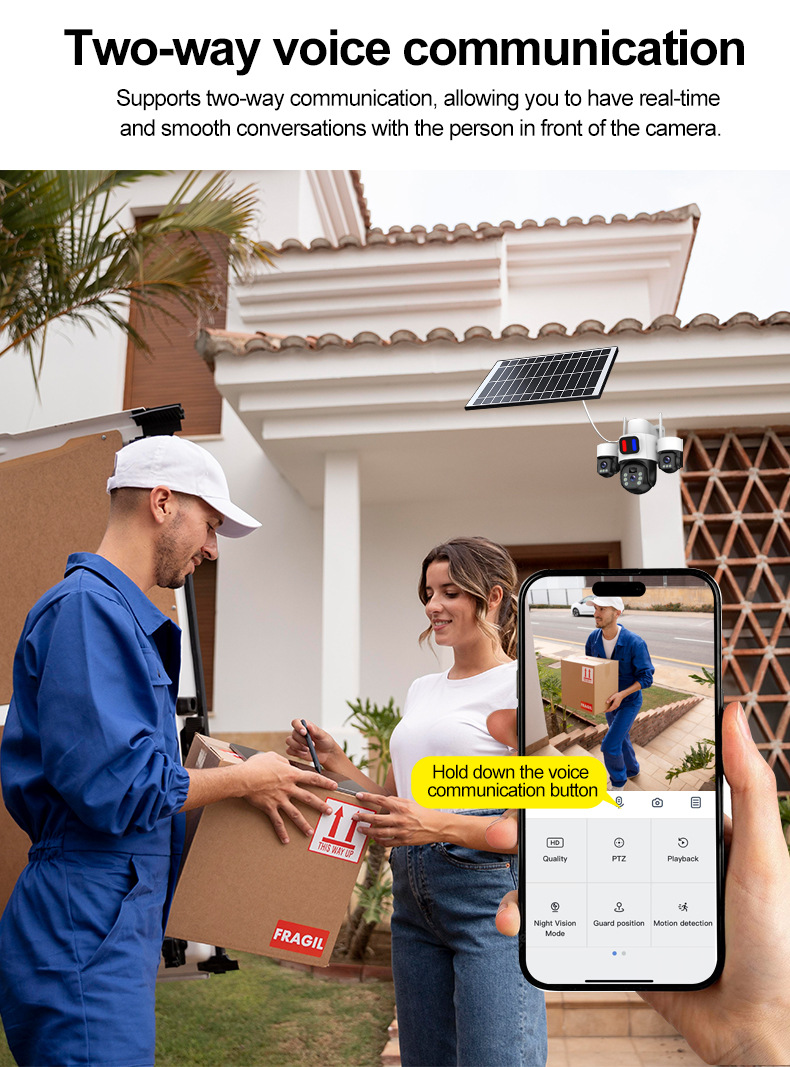
* Two-way Audio: Supports two-way voice intercom;
* Night Vision Mode: Infrared mode / Full-color mode;
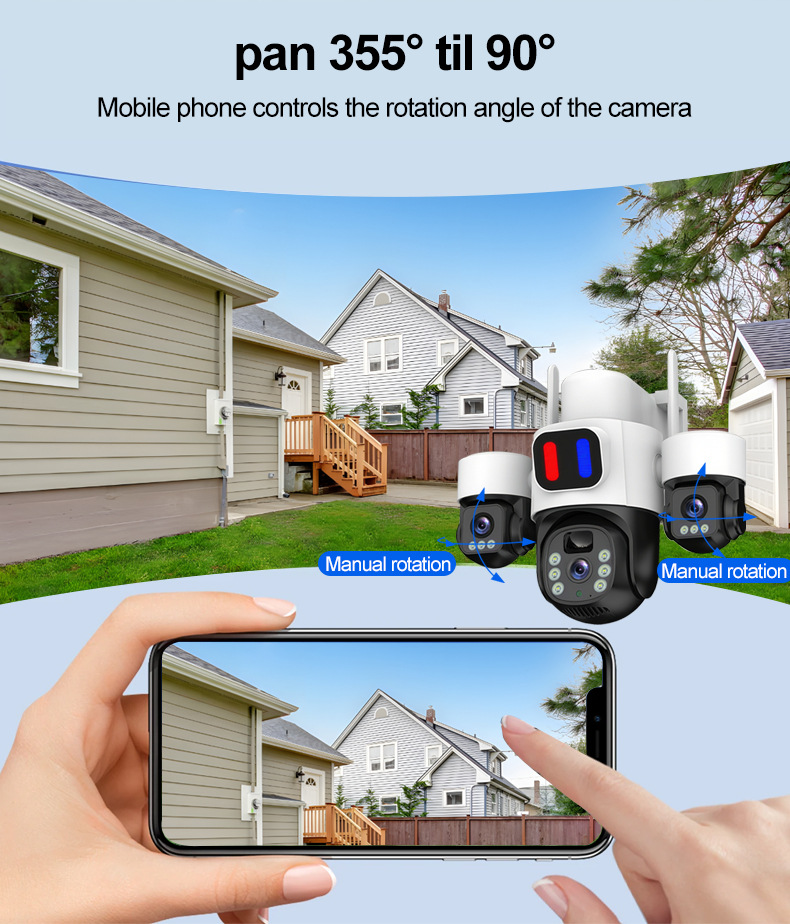
* PTZ Rotation: PTZ supports 355° left and right, 90° up and down;
* Application Software: Supports iOS and Android;
* PIR Detection Range: PIR range 10 meters, 120 degrees;
* Operating Temperature: -20°C ~ 55°C;
* Operating Humidity: 20% ~ 80%;
* Solar Panel Power: 7.5W;
* Charging Interface: 5V Type-C interface;
* Battery Capacity: 10800mAh (6 batteries);
* Package Contents: Camera, 7.5W solar panel, solar panel plastic bracket, instruction manual, screw pack.

Off-Grid Solar-Powered Multi-Lens Surveillance Camera System with Active Deterrence

Product Details

Off-Grid Solar-Powered Multi-Lens Surveillance Camera System with Active Deterrence


Engineering Conclusion


This off-grid solar-powered multi-lens surveillance camera system with active deterrence is engineered for remote and unattended sites where simultaneous multi-directional visual coverage and immediate on-site response are required under constrained energy conditions.
System suitability is determined by coverage continuity, response latency tolerance, and energy autonomy management, rather than by lens count or deterrence output alone.

Engineering Problem This System Addresses


In many off-grid surveillance deployments, critical events occur unpredictably and often outside the viewing direction of a single camera or the rotation window of a PTZ system.
Mechanical repositioning introduces response latency, while blind zones increase missed-detection risk—especially in high-risk or unattended environments.

This system addresses these challenges by combining fixed multi-lens optical coverage, autonomous power supply, and event-driven active deterrence, reducing reliance on mechanical movement and external response workflows.

System Architecture Overview


The system integrates photovoltaic generation, onboard energy storage, multi-lens visual sensing, and active deterrence mechanisms into a unified off-grid platform.
Each optical channel provides continuous directional awareness, while power generation, storage, and response logic are coordinated through centralized energy-aware control.

By distributing visual responsibility across multiple lenses, the architecture minimizes mechanical dependency and enables consistent situational awareness without continuous PTZ actuation.

Why Multi-Lens Architecture Matters in Off-Grid Surveillance


Multi-lens architecture enables simultaneous monitoring of multiple directions, eliminating coverage gaps caused by camera rotation or delayed repositioning.
This is particularly critical in environments where events are brief, unpredictable, or concurrent across different zones.

Unlike PTZ-centric systems, multi-lens configurations preserve coverage continuity even during response escalation, ensuring that deterrence actions do not compromise ongoing observation.

Role of Active Deterrence in Multi-Lens Deployments


Active deterrence provides an immediate response layer that operates independently of camera orientation.
When integrated into a multi-lens system, deterrence can be triggered by any optical channel without waiting for mechanical alignment or operator intervention.

This decoupling reduces response latency and enhances system effectiveness in environments where delayed human response increases operational risk.

Engineering Boundary Conditions & Design Assumptions


This system is designed and validated under the following engineering boundary conditions, which define operational applicability:
✅ Grid Availability Constraint
Intended for locations without stable grid access or where cabling and trenching introduce unacceptable cost or reliability risk.

✅ Solar Resource Assumption
Energy autonomy calculations are based on realistic daily solar irradiation patterns observed across diverse geographic regions rather than peak laboratory values.

✅ Energy Variability Window
System operation accounts for extended low-generation periods, during which prioritized optical coverage and response logic are maintained.

✅ Environmental Exposure Limits
Designed for outdoor deployment under wind, dust, rainfall, and temperature conditions typical of rural infrastructure, construction zones, and remote assets.

✅ Maintenance Access Constraint
Optimized for long inspection intervals where reactive maintenance access is limited or costly.

Decision-Relevant Parameters


The following parameters are presented as engineering decision variables rather than isolated specifications:

Optical Channel Allocation


Lens count and orientation are selected to balance coverage density with energy consumption, ensuring continuous multi-directional awareness without excessive power draw.

Energy Storage Capacity


Battery sizing supports simultaneous multi-lens operation and event-driven deterrence during extended low-irradiance periods.

Power-Aware Control Logic


System logic prioritizes essential optical channels and response functions under constrained energy conditions to preserve baseline surveillance continuity.

Deterrence Activation Strategy


Deterrence output is designed for event-triggered operation rather than continuous signaling, preventing unnecessary energy depletion.

Integrated System Architecture


Consolidation of sensing, power, and response functions reduces external wiring and minimizes long-term failure points in outdoor deployments.

Engineering Decision Rationale


From an engineering decision perspective, this architecture is selected to reduce missed-detection risk and response latency, rather than to maximize component counts:

✅ Multi-lens coverage eliminates blind zones inherent to single-axis observation
✅ Reduced mechanical dependence improves reliability in unattended environments
✅ Active deterrence shortens the gap between detection and response
✅ Energy autonomy governs system effectiveness more than nominal output ratings
✅ Power-aware prioritization preserves long-term operational stability

Engineering Comparison: Multi-Lens vs PTZ vs Camera-Only Systems


This comparison addresses engineering decision trade-offs, not feature lists, between three common off-grid surveillance architectures.

Primary Engineering Objective


Camera-Only Systems
Optimized for evidence capture and passive monitoring where response actions are handled remotely and coverage direction is predictable.

PTZ-Based Systems
Designed to expand coverage through mechanical movement, suitable when repositioning latency does not materially increase risk.

Multi-Lens Systems with Active Deterrence
Engineered for environments requiring simultaneous coverage, minimal response latency, and on-site escalation under unattended conditions.

Response Logic and Risk Mitigation


Camera-only and PTZ systems rely on external response workflows and communication latency.
Multi-lens deterrence-enabled systems introduce a local response layer, enabling immediate on-site escalation independent of camera orientation.

Energy Autonomy Impact


Camera-only architectures prioritize extended autonomy with simplified load profiles.
PTZ systems introduce intermittent mechanical loads.
Multi-lens deterrence systems allocate energy across parallel optical channels and event-driven deterrence, making autonomy design and prioritization logic central to reliability.

Operational Complexity and Maintenance Considerations


PTZ systems introduce mechanical wear and alignment dependency.
Multi-lens systems reduce mechanical reliance but require disciplined power-aware control logic.
Integrated deterrence avoids adding standalone alarm devices, which are common long-term failure points in outdoor deployments.

Engineering Decision Summary


Selecting between these architectures is a risk and response strategy decision, not a feature comparison:
✅ Camera-only systems favor simplicity and efficiency
✅ PTZ systems favor flexible coverage with acceptable latency
✅ Multi-lens deterrence systems favor immediacy, redundancy, and unattended reliability

The correct choice depends on response latency tolerance, coverage continuity requirements, and acceptable operational risk.

Operational Reliability & Long-Term Maintenance Logic


Operational reliability is achieved by aligning optical coverage, energy storage, and response activation within defined autonomy boundaries.
By minimizing mechanical actuation and external interfaces, the system reduces wear-related degradation and supports predictable maintenance planning.

Active deterrence operates within controlled duty cycles, ensuring response capability without compromising baseline monitoring functions.

Engineering Decision Q&A


Under what conditions is a multi-lens off-grid surveillance system the correct engineering choice?


When simultaneous multi-directional coverage is required and repositioning latency or blind zones introduce unacceptable risk.

How does active deterrence improve effectiveness in multi-lens systems?


By enabling immediate on-site response independent of camera orientation or operator intervention.

How does energy autonomy influence multi-lens system behavior?


Energy autonomy defines how many optical channels and response functions remain active during extended low-generation periods.

When does simultaneous multi-lens operation become constrained?


Only when cumulative low-irradiance duration exceeds the designed autonomy window, triggering prioritized coverage modes.

Is this system suitable for permanent unattended deployment?


Yes, provided deployment conditions align with defined assumptions regarding solar availability, environmental exposure, and response duty cycles.

Engineering Takeaway


This off-grid solar-powered multi-lens surveillance camera system with active deterrence should be evaluated as a coverage-continuity and response-latency mitigation architecture, not as a camera aggregation.
Its suitability depends on how effectively it balances simultaneous observation, energy autonomy, and event-driven response under real-world operating constraints.
Product Structure

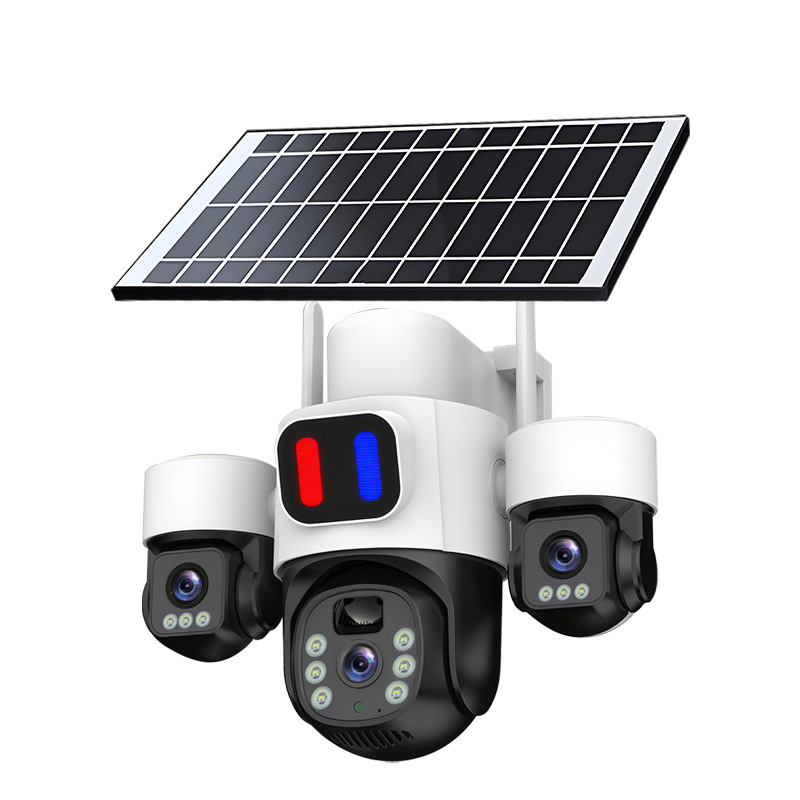
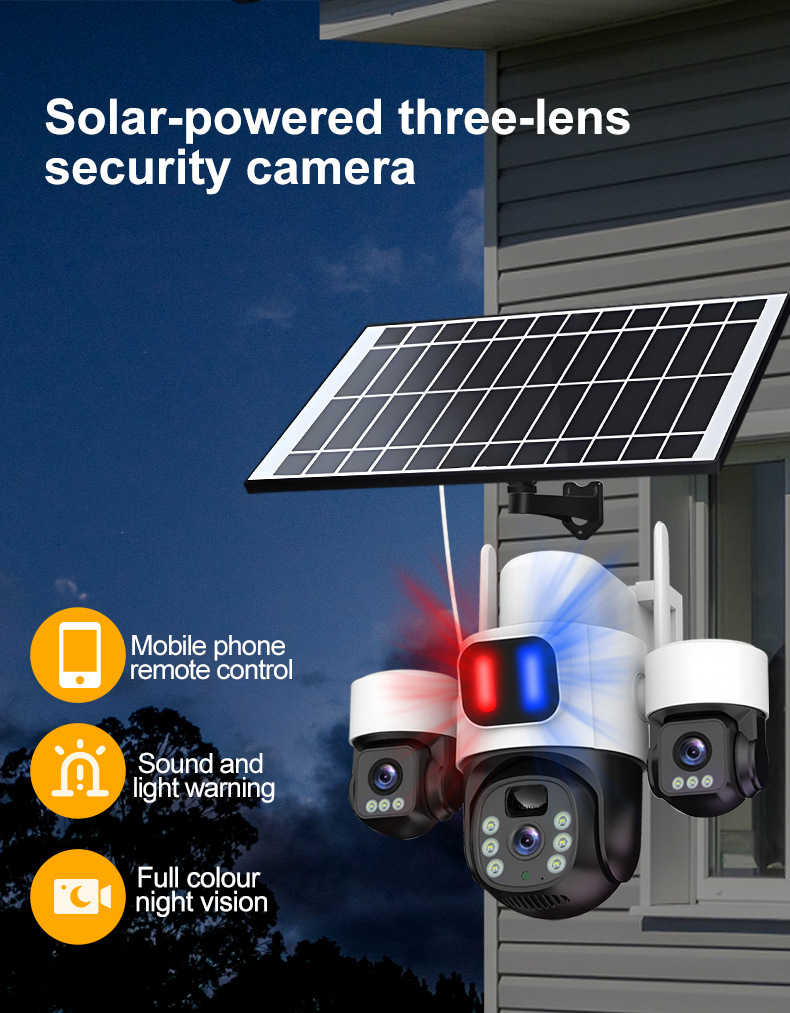
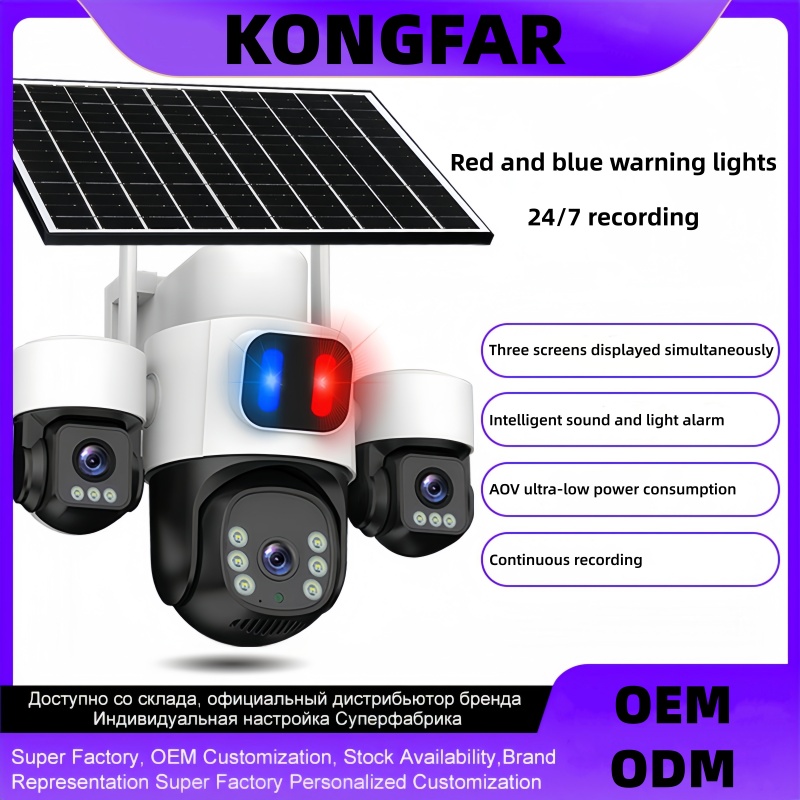
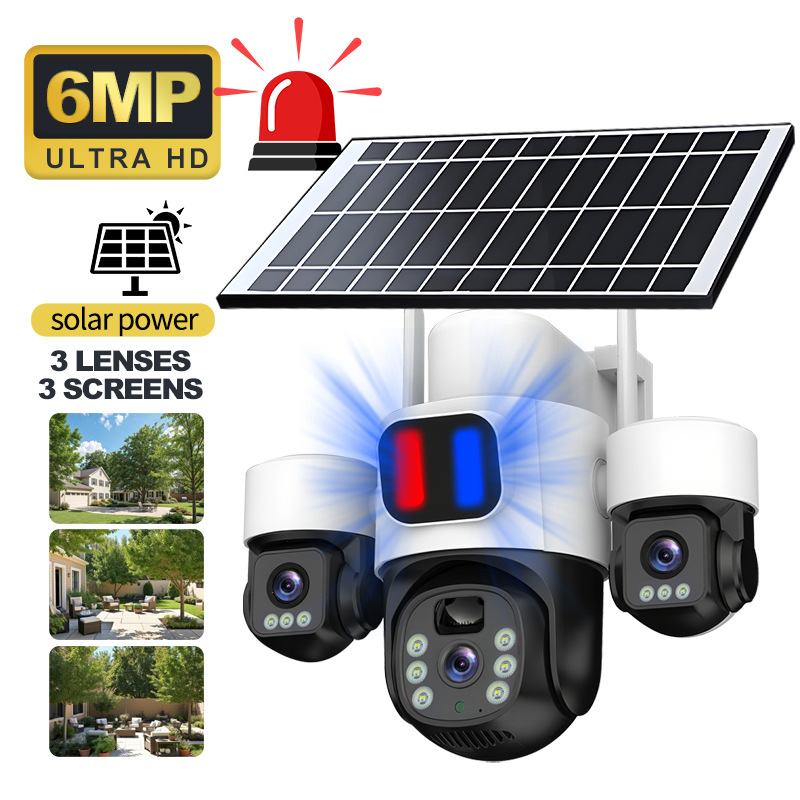
Solar powered three lens security camera structural design showing integrated solar panel multi lens modules and warning light unit for outdoor surveillance
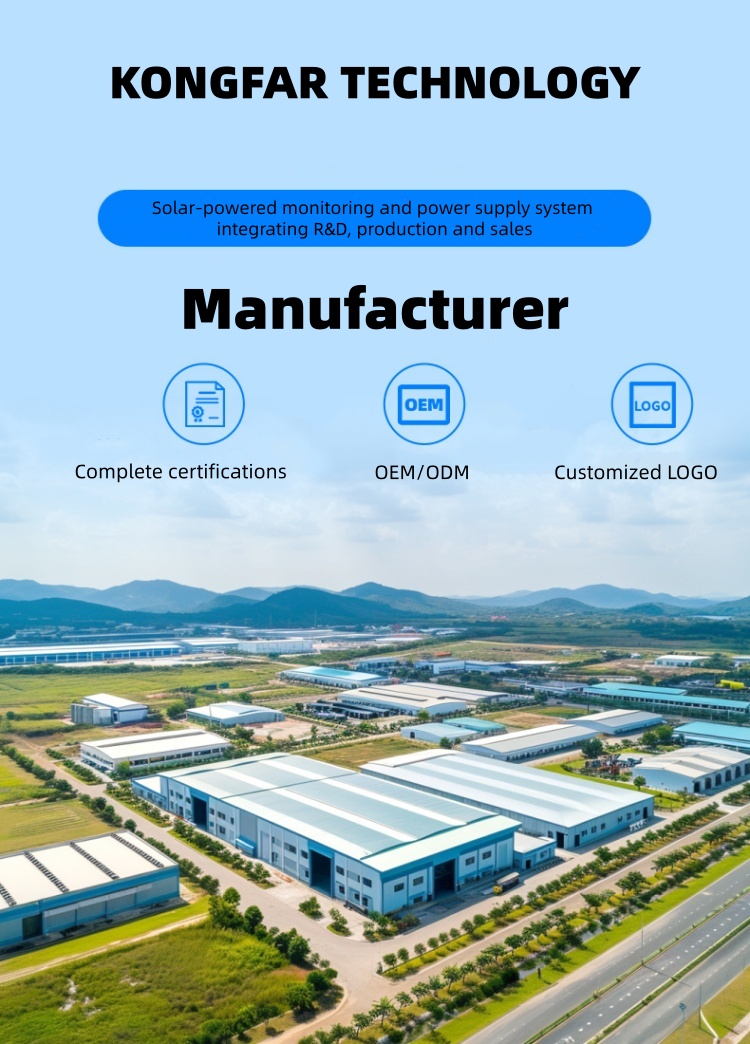
Aerial view of a solar security camera manufacturing facility showing integrated R&D, production, and OEM ODM capabilities for solar-powered monitoring systems

Manufacturer-Level Integration for Solar-Powered Monitoring Systems


This product is backed by Shenzhen Kongfar Technology Co., Ltd., a manufacturer specializing in solar-powered monitoring and power supply systems with integrated R&D, production, and global delivery capabilities.
Unlike trading-based supply models, Kongfar operates a vertically integrated manufacturing framework that controls system design, component selection, assembly, testing, and OEM/ODM execution under one roof.


The manufacturing base supports projects requiring off-grid solar surveillance equipment for infrastructure, agriculture, energy, and remote-area security deployments across multiple regions, including North America, Europe, Australia, and emerging off-grid markets.
This structure ensures compliance alignment, stable lead times, and consistent system performance across varied environmental and regulatory conditions.


With complete certifications, OEM/ODM customization pathways, and brand-level logo integration, the factory setup is designed to support B2B procurement, system integrators, and project-based buyers seeking long-term supply continuity rather than one-off devices.

End-to-End Manufacturing Workflow for Solar-Powered Surveillance Systems


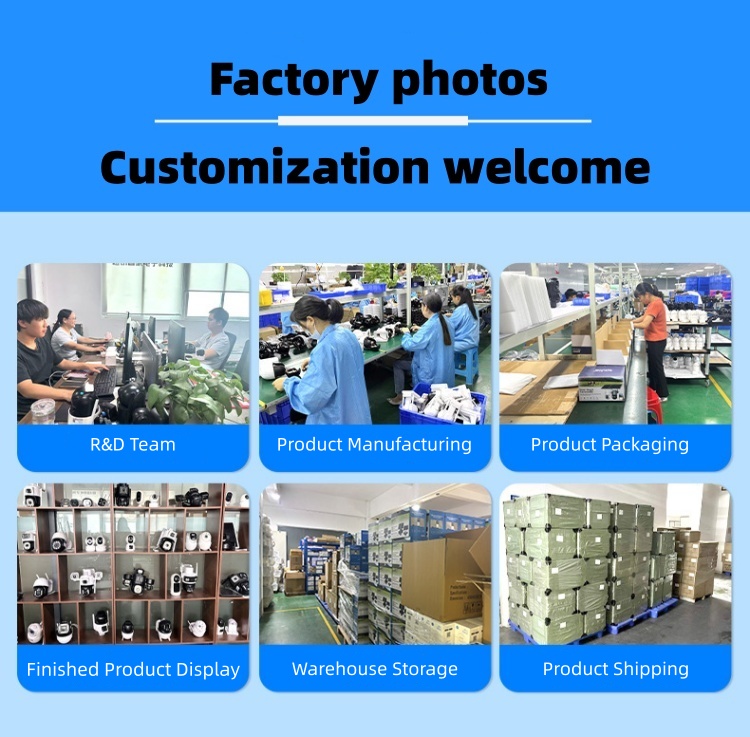
This system is supported by a full-cycle manufacturing workflow, covering R&D engineering, component assembly, system integration, packaging, warehousing, and outbound logistics.
Each stage operates within a controlled production environment to ensure consistency, traceability, and repeatability for solar-powered surveillance systems supplied to project-based and OEM customers.


The in-house R&D team focuses on system architecture, power matching, and environmental adaptability, while dedicated production lines handle device assembly and functional testing under standardized procedures.
Finished units undergo structured packaging and inventory management, enabling stable delivery for batch orders, customized configurations, and long-term supply agreements.


This manufacturing structure is designed to support OEM/ODM customization, regional compliance requirements, and multi-market deployment, providing system integrators and distributors with a reliable production and shipping foundation for off-grid monitoring applications.

Factory photos showing research, manufacturing, packaging, warehouse storage, and shipping processes for solar-powered security cameras
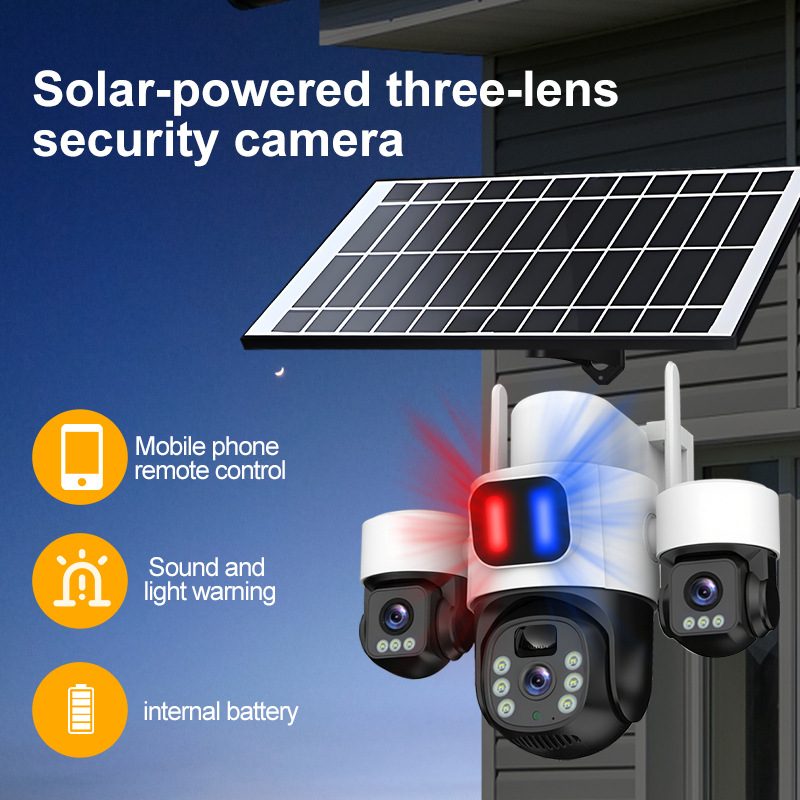
Solar powered three lens security camera with mobile remote control, sound and light warning, and full color night vision for outdoor surveillance applications

Multi-Angle Active Deterrence Architecture for Off-Grid Surveillance

The solar-powered three-lens security camera is engineered to provide continuous multi-directional coverage in off-grid surveillance environments where single-lens systems leave blind zones and delayed response risks.

By combining a fixed wide-angle lens with dual PTZ-controlled lenses, this architecture enables simultaneous area awareness and target-focused tracking without relying on grid power.

This structure is essential in remote residential perimeters, farms, construction sites, and other unattended locations where intrusions must be detected, illuminated, and deterred immediately rather than reviewed after the fact.

Integrated sound and light warning functions transform detection into active deterrence, reducing reliance on human intervention while maintaining stable long-term operation under solar-only power conditions.

Continuous Solar Energy Architecture for Autonomous Surveillance Systems

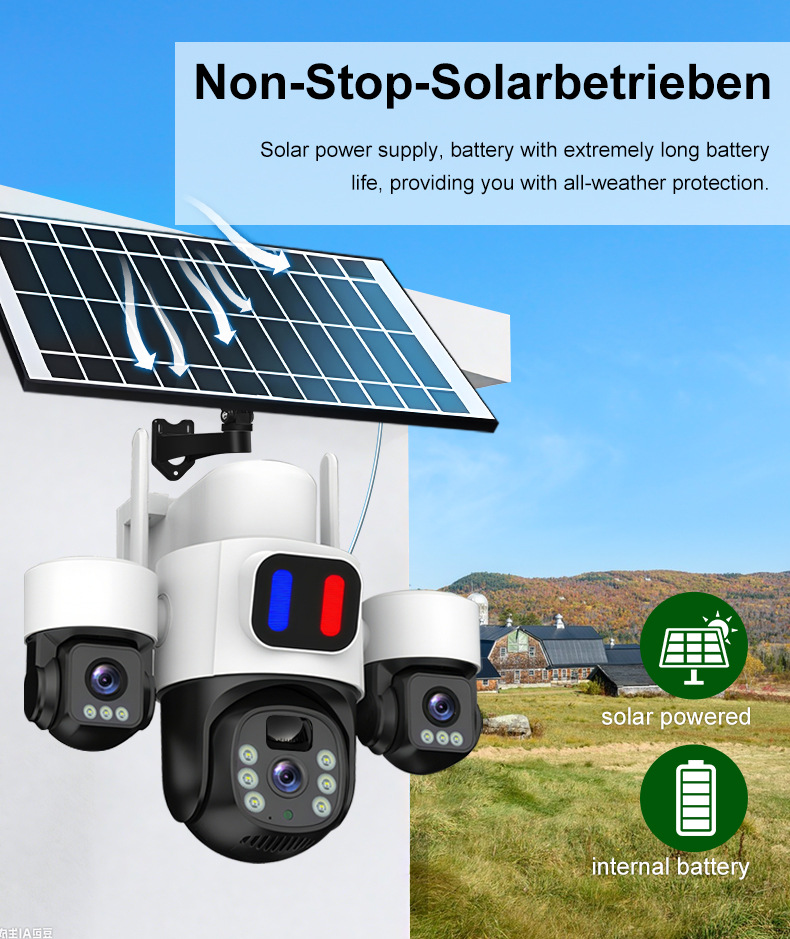
The solar-powered three-lens security camera is built around a continuous energy architecture that combines photovoltaic generation with internal battery buffering to support uninterrupted operation in off-grid deployments.

The solar panel converts daylight energy into usable power while simultaneously charging the internal battery, allowing the system to maintain full surveillance functionality during nighttime, overcast conditions, and seasonal low-irradiance periods.

This architecture is essential for multi-lens surveillance systems, where increased imaging, tracking, and deterrence functions impose higher and more sustained power demands than single-lens devices. Without integrated energy buffering, coverage gaps and delayed response become unavoidable in remote environments.

Such a design is particularly required in rural properties, farms, perimeter installations, and unattended sites where grid access is unavailable and manual battery replacement is impractical.

By decoupling system reliability from grid dependency, this energy structure enables long-term autonomous operation with minimal maintenance while preserving continuous monitoring and active deterrence capabilities.

Solar powered three lens security camera with solar panel and internal battery designed for continuous off grid outdoor monitoring
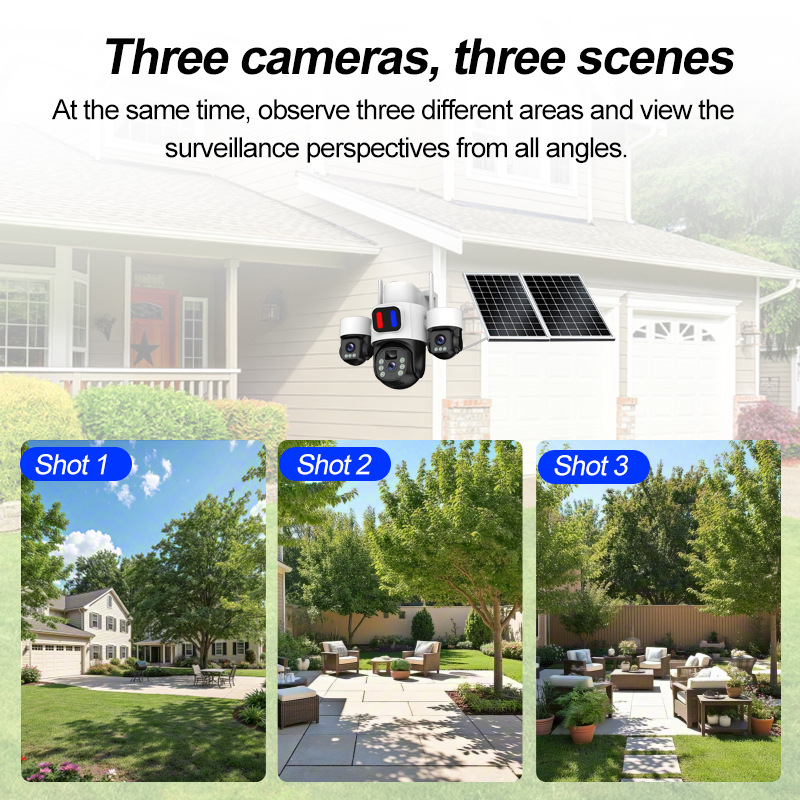
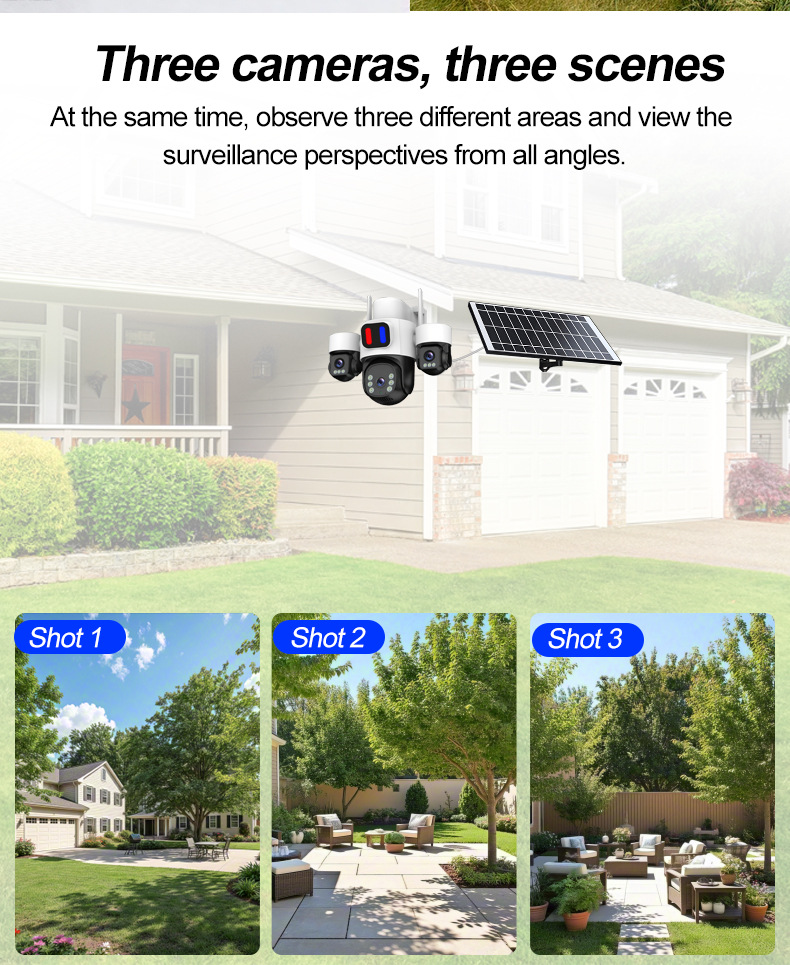
Solar powered three lens security camera providing simultaneous multi area surveillance for residential and outdoor security monitoring

Parallel Multi-View Surveillance Architecture for Blind-Spot Elimination

The solar-powered three-lens security camera adopts a parallel multi-view surveillance architecture that enables simultaneous monitoring of multiple independent zones from a single installation point.

Each lens is assigned a fixed observation role, allowing the system to maintain continuous visibility across separate areas without relying on mechanical rotation or time-sliced camera switching.

This structure is critical in residential and perimeter environments where activities may occur concurrently in different directions, and where pan–tilt sequencing would otherwise introduce coverage delays or missed events.

By distributing surveillance tasks across multiple optical channels, the system reduces blind spots and preserves full situational awareness in front yards, side areas, and rear spaces at the same time.

The result is consistent, real-time coverage across multiple scenes without increasing installation complexity or requiring additional mounting locations.

Controlled Pan–Tilt Motion Architecture for Dynamic Coverage Reconfiguration

The solar-powered three-lens security camera integrates a controlled pan–tilt motion system that allows surveillance viewpoints to be reconfigured without relocating the installation point.

With a horizontal rotation range of up to 355° and a vertical tilt range of 90°, the system enables operators to reposition active viewing angles in response to changing site conditions rather than relying on fixed camera geometry.

This motion-controlled design is essential in residential yards and perimeter zones where access paths, activity areas, or obstructions may shift over time, and where static field-of-view coverage would leave temporary blind spots.

By combining mechanical motion control with remote viewpoint adjustment, the system maintains adaptable coverage while preserving installation simplicity and long-term operational stability.

Solar powered three lens security camera with pan and tilt control operated via mobile phone for multi angle outdoor surveillance
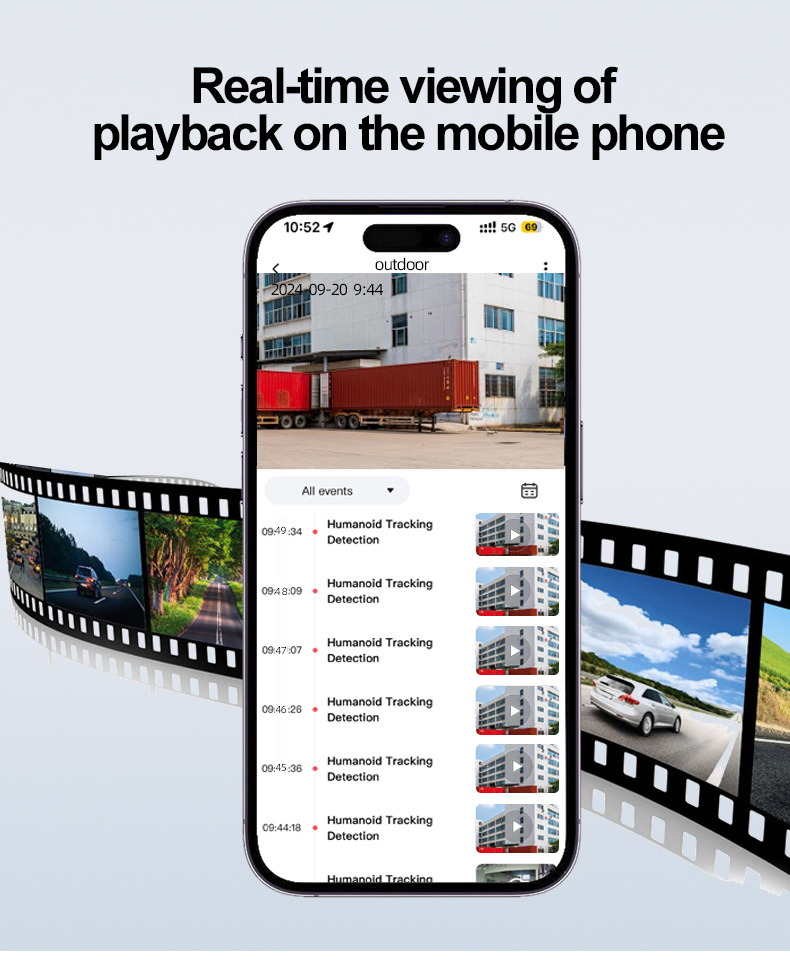
Mobile phone displaying real-time monitoring and playback interface for a solar-powered outdoor security camera system

Event-Indexed Remote Video Access for Surveillance Evidence Review

The solar-powered three-lens security camera implements an event-indexed video access architecture that enables remote viewing and playback based on detected activity rather than continuous manual searching.

By automatically associating video segments with motion and humanoid detection timestamps, the system allows users to retrieve relevant footage directly from a chronological event list, even when operating off-site.

This structure is essential in perimeter monitoring, roadside observation, and unattended locations where incidents must be reviewed after occurrence rather than observed in real time.

Through event-driven indexing and remote access, the system reduces review time, improves incident traceability, and supports practical evidence verification without on-site intervention.

Remote Two-Way Audio Intervention for On-Site Event Handling

The solar-powered three-lens security camera integrates a two-way audio intervention channel that enables remote personnel to actively engage with individuals present at the monitored location.

Rather than serving as passive communication, this audio pathway allows real-time verbal guidance, warning, or verification during detected events, supporting immediate behavioral influence without physical presence.

This capability is critical for unattended residences, delivery zones, and perimeter access points where visual confirmation alone cannot prevent escalation or misunderstanding.

By enabling live remote interaction, the system transforms surveillance from observation into controlled response, reducing unnecessary dispatch, improving situational clarity, and supporting safer incident resolution.

Solar-powered outdoor security camera supporting two-way voice communication with visitors via mobile application
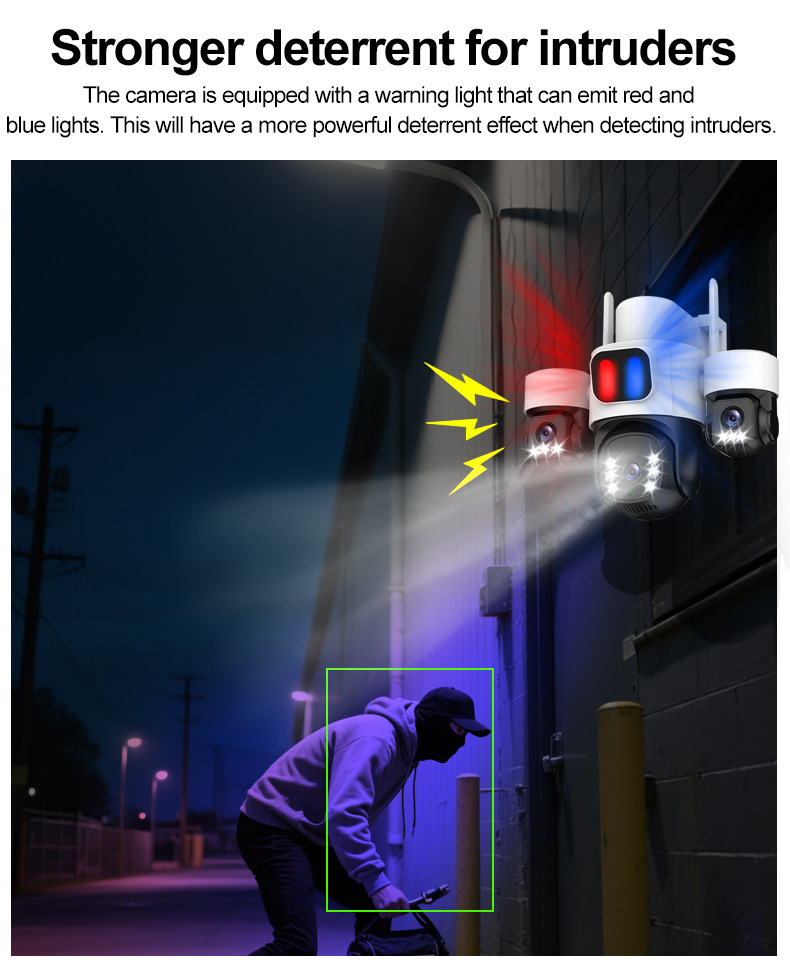
Solar-powered outdoor security camera using light and sound warning to deter intruders during nighttime surveillance

Event-Triggered Active Deterrence Through Visual and Acoustic Signals

The solar-powered three-lens security camera incorporates an event-triggered active deterrence mechanism that combines high-visibility warning lights with immediate on-device signaling once an intrusion is confirmed.

Rather than relying solely on recording, this response introduces a perceptible intervention that alters intruder behavior at the earliest stage of an event.

Such deterrence is essential in low-light alleys, unattended building exteriors, and perimeter zones where response time is limited and passive surveillance offers no immediate risk to the intruder.

By converting detection into instant behavioral pressure, the system reduces escalation likelihood, shortens intrusion duration, and improves overall site security without requiring human presence.

Day–Night Imaging Consistency for Evidence-Grade Surveillance

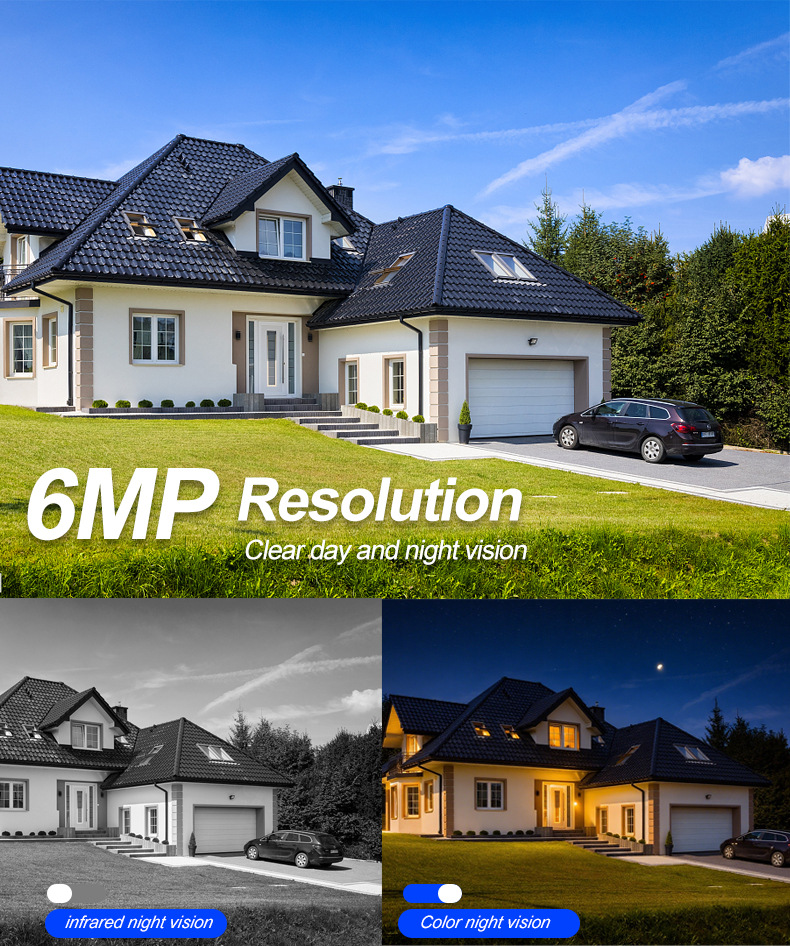
The solar-powered three-lens security camera delivers consistent 6MP imaging performance across daylight, infrared night vision, and full-color low-light conditions, ensuring target details remain identifiable rather than merely visible.

This level of resolution is critical in residential perimeters, driveways, and unattended properties where motion events often occur during lighting transitions.

By maintaining scene structure, object contours, and contextual clarity in both monochrome and color night modes, the system supports reliable event verification and post-incident review without dependence on external lighting.

Such imaging consistency directly improves evidentiary usability and reduces false interpretation caused by low-resolution or contrast-limited night footage.

Solar-powered outdoor security camera showing 6MP resolution with clear daytime imaging, infrared night vision, and color night surveillance performance
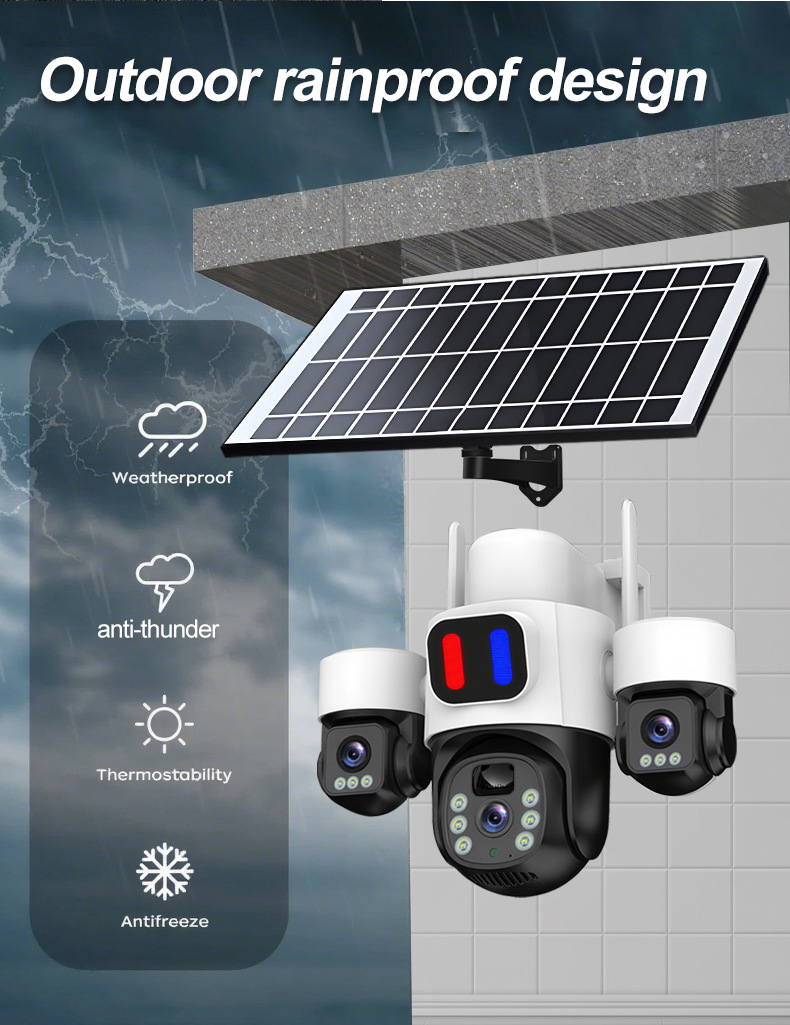
Outdoor rainproof solar-powered CCTV camera installed on a building exterior, demonstrating all-weather protection design for off-grid security monitoring applications

Environmental Hardening for Continuous Outdoor Operation

The solar-powered three-lens security camera is engineered to maintain operational stability under rain exposure, temperature fluctuations, and electrical disturbances commonly encountered in outdoor installations.

This environmental hardening is essential for locations where surveillance systems must remain active through seasonal weather changes, including prolonged rainfall, cold conditions, and high humidity.

By protecting internal components and power interfaces from moisture ingress and thermal stress, the system reduces unplanned downtime and performance degradation over time.

Such resilience ensures consistent monitoring output in residential exteriors, rural properties, and unattended sites where maintenance access is limited.

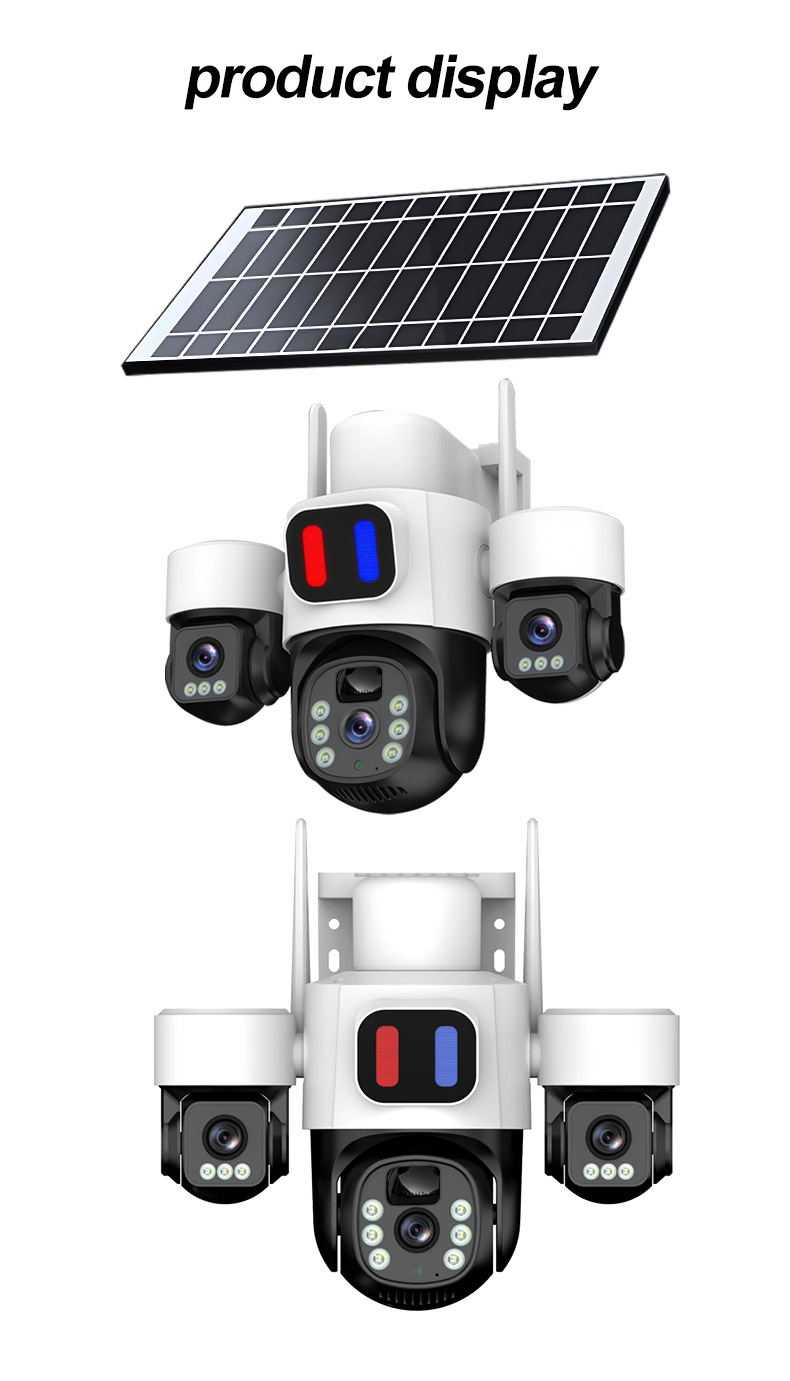
Integrated System Architecture Overview

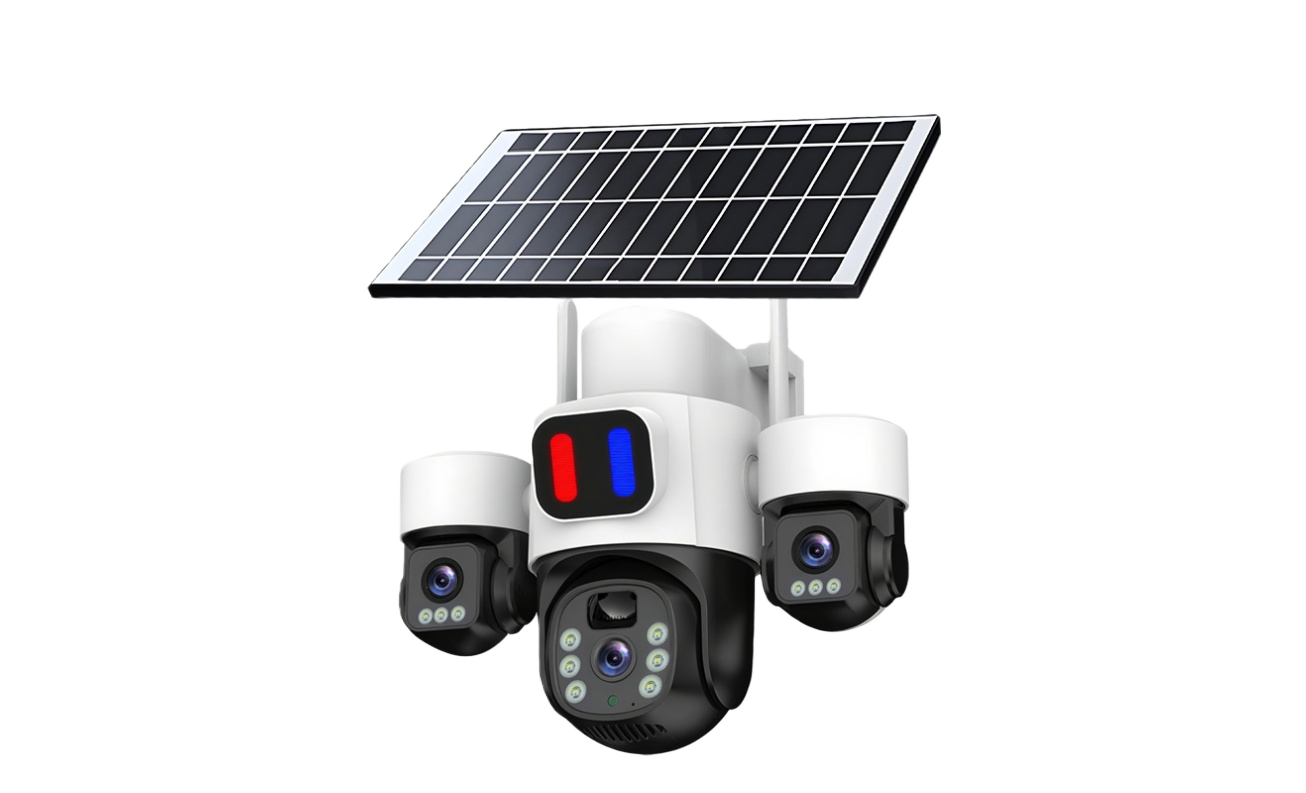
The solar-powered three-lens security camera system is composed of an independent solar energy module, a centralized control housing, and three coordinated imaging units designed for simultaneous multi-directional coverage.

This architecture separates power generation, processing, and visual sensing into clearly defined physical modules, reducing system coupling and improving long-term operational stability.

By structuring the system as an integrated but modular assembly, installation flexibility is maintained while ensuring consistent performance across different mounting positions and outdoor environments.

Such a configuration is particularly suitable for perimeter monitoring, residential exteriors, and locations where reliable coverage must be achieved without grid dependency.

Solar-powered triple-lens CCTV security camera product display showing integrated solar panel and multi-angle surveillance camera structure for outdoor monitoring

For more application scenarios,
please contact customer service

Off-Grid Solar-Powered Multi-Lens Surveillance Camera System with Active Deterrence

Subscribe to the latest news of kongfar technology

I agree to receive emails about product and service updates in accordance with the Privacy Policy